





AUVY
DEBook a walkthrough

Seven chapters · about eight minutes · 10 sources

A field guide to the ground we build on.

AI is becoming infrastructure, like power and water. So it matters who owns it, where it runs and what it burns. Seven chapters, named after the land. Every figure has a source.

Plate IBedrock

Who owns the ground.

Europe spends more on cloud every year. Less and less of it goes to European companies.

In 2024, companies in Europe spent about €61 billion on cloud infrastructure. Three American providers took roughly 70% of it. European providers have held around 15% since 2022, down from 29% in 2017.

European providers kept growing: they tripled their cloud revenue between 2017 and 2024. The market around them grew sixfold, so the ground kept shifting under their feet.

€61bn
European cloud market, 20241
70%
held by three US providers1
15%
held by European providers1
Fig. 1European providers' share of Europe's cloud market
29%2017
15%2024
−14percentage points in seven years

A smaller share of a market that keeps growing.1

1Synergy Research Group

Plate IIRivers

Where the data flows.

Data is like water: it goes where the ground lets it. We draw the banks on purpose, and we say where they leak.

Every AUVY feature has a region, and every region is written down. Workspace and account data stays on our servers in Helsinki. AI models and speech-to-text run in Sweden.

Not everything stays inside. Some service metadata, like email delivery and the edge network, is processed outside the EU, and optional document parsing may use the provider's regions when you use it. We list it rather than hide it.

Fig. 2Where each part of AUVY runs2
  • Workspace and account dataHelsinki, our servers
  • Live collaborationHelsinki, our servers
  • AI modelsEU, Sweden
  • WebsiteEU, Frankfurt
  • Speech-to-textSweden (EU)
  • Web searchEU
  • Some service metadataOutside the EU, listed
  • Optional document parsingProvider regions, when used
Every subprocessor and region: trust.auvy.ai ↗

2AUVY Trust Center

Plate IIIWeather

What AI does to the sky.

Data centres are on track to use twice the electricity by 2030. Where AI runs decides how much of that becomes CO₂.

Data centres worldwide used about 415 TWh of electricity in 2024, around 1.5% of the world's total. The IEA expects about 945 TWh by 2030, just under 3%, with AI servers growing around 30% a year.

In the EU, data centres used about 70 TWh in 2024 and are expected to reach about 115 TWh by 2030. The EU plans to triple its data centre capacity within five to seven years.

A single AI prompt is small: Google measured its median text prompt at 0.24 Wh, 33 times less than a year earlier. But the same prompt emits very different amounts of CO₂ depending on the grid it runs on.

945TWh
data centres worldwide by 2030, up from 4153
115TWh
data centres in the EU by 2030, up from 704
0.24Wh
median text prompt, Google, 20258
Fig. 3Electricity used by data centres · TWh
World32030 · 9452024 · 415
EU42030 · 1152024 · 70
Fig. 4Same electricity, different sky

CO₂ per kWh. EU, Sweden, Germany and Poland: electricity generated in 2023. Finland: electricity consumed in 2024. AUVY runs in Finland and Sweden.67

Fig. 5Try it: one prompt, four skies

Take the median prompt Google measured, 0.24 Wh, and run it on each grid.8

20.7 × between the cleanest and the heaviest grid

An illustration from published figures, not a measurement of AUVY.

3International Energy Agency4European Parliamentary Research Service5European Commission6Ember7Fingrid8Google

Plate IVMycelium

The smallest thing that does the job.

A forest doesn't send everything to the biggest tree. It routes through a network, and only what needs to goes far.

Most AI work doesn't need the largest model. One study estimates that choosing the right-sized model for each task could cut AI's energy use by about 28%, around 32 TWh in 2025, roughly what five nuclear reactors produce in a year.

Small models used 3 to 11 times less energy per query than a 14-billion-parameter model in another study. The saving is not in the model. It is in the choice.

27.8%
less AI energy with right-sized models9
31.9TWh
saved in 2025, about five reactors9
3–11×
less energy per query, small vs. 14B model10
Fig. 6How AUVY's router sorts the work
glanceShort, clear jobs. The smallest model that answers well.
workMost jobs. A capable model, still sized to the task.
deepHard, long reasoning. The only lane that escalates.

↳ only deep escalates

9da Silva Barros, Giroire, Aparicio-Pardo, Moulierac10OpenReview

Plate VHarvest

Where the value lands.

Every euro spent on cloud and AI is a harvest. The question is whose fields it feeds.

Of Europe's €61 billion cloud market in 2024, about €43 billion went to three American providers. That is revenue, margin and know-how that grow somewhere else.

Europe has decided to plant: the Commission's InvestAI initiative aims to mobilise €200 billion for AI. Money builds capacity. Companies that use it well build the rest.

€43bn
to three US providers in 2024 (≈70% of €61bn)1
€200bn
InvestAI, the EU's AI investment goal5
Fig. 7Europe's €61bn cloud market, 20241
70%15%15%
  • Three US providers
  • European providers
  • Everyone else

InvestAI aims to mobilise €200bn for AI in Europe.5

1Synergy Research Group5European Commission

Plate VIForest

What grows from one root.

The same core that carries a project team's changes can carry other kinds of change. So we plant companies on it, one at a time, each on its own evidence.

Every venture starts with a real customer, gets its own budget and owner, and becomes its own company on its own EU cluster. Each one moves forward, or stops, on what customers do.

  1. 01

    A real customer first

    No venture without someone who has the problem and will pay to solve it.

  2. 02

    A budget and an owner

    Before it grows, it needs its own money and a person who answers for it.

  3. 03

    Its own company

    A separate company on its own EU cluster, run by AUVY until it has its own team.

  4. 04

    Evidence decides

    Each one moves forward, or stops, on what customers do, not on what we hope.

Ventures

Protocols

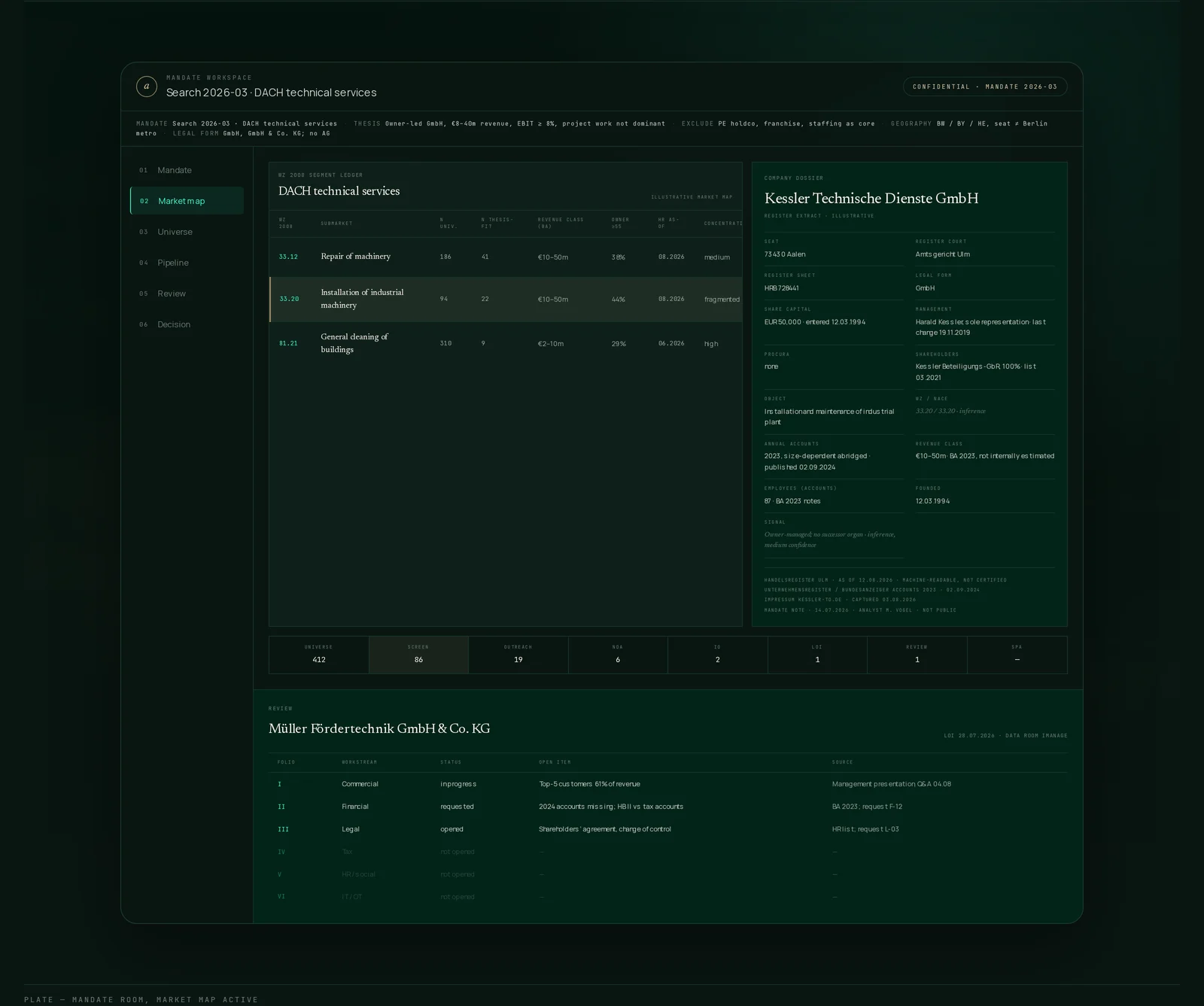
akolo

exploring

The structured platform for search funds and ETA teams: map a market, source targets, screen deals and reach the investment decision in one workspace.

For
Search funds, ETA teams, family offices and M&A teams buying companies in Germany, Austria and Switzerland.
Where it stands
Design-partner pilot open: akolo is set up on a real search thesis or a live pipeline.

What happens next

  1. 1Run the pilot on real searches with design partners
  2. 2Settle the deal-quality model with them
  3. 3Its own team, then spin off

Runs on

  • Agent runtime
  • Evidence store
  • OpenPulse sign-in
Plate VIISeasons

What happens next.

We are not launched. We are opening, one project team at a time.

  1. Autumn · now

    Opening to first project teams, by invitation. A walkthrough on one of your own projects.

  2. Winter

    Every change those teams bring makes AUVY sharper. We fix what they hit, fast.

  3. Spring

    More teams, one project each. The ventures move on their own evidence, or stop.

In short.

  1. IBedrock

    Most of Europe's cloud belongs to three American companies. AUVY runs its own stack in Helsinki.

  2. IIRivers

    Every part of AUVY has a region, and what leaves the EU is listed, not hidden.

  3. IIIWeather

    Data centres are set to use twice the electricity by 2030. The same prompt emits about twenty times more CO₂ on Europe's heaviest grid than on its cleanest.

  4. IVMycelium

    Right-sized models cut AI's energy by about a quarter. AUVY's router starts small and only escalates when it must.

  5. VHarvest

    Most of the value of Europe's cloud grows elsewhere. AUVY and the companies it starts are European.

  6. VIForest

    The same core carries other companies, each on its own customers and evidence.

  7. VIISeasons

    We're opening to first project teams now. A person decides, always.

Sources

Every figure on this page, where it comes from, and what it backs. Checked on 24 September 2026.

No.SourceBacks
1Synergy Research GroupEuropean cloud providers' local market share now holds steady at 15% · 2025 ↗BedrockHarvest
2AUVY Trust CenterData handling, regions and subprocessors · 2026 ↗Rivers
3International Energy AgencyEnergy and AI · 2025 ↗Weather
4European Parliamentary Research ServiceBriefing on data centres in the EU, citing the IEA · 2025 ↗Weather
5European CommissionAI Continent Action Plan and InvestAI · 2025 ↗WeatherHarvest
6EmberEuropean Electricity Review 2024: emissions intensity of generation, 2023 · 2024 ↗Weather
7FingridEmission factor of electricity consumed in Finland, 2024 (financial statements bulletin) · 2025 ↗Weather
8GoogleMeasuring the environmental impact of delivering AI at Google scale (arXiv 2508.15734) · 2025 ↗Weather
9da Silva Barros, Giroire, Aparicio-Pardo, MoulieracSmall is Sufficient: Reducing the World AI Energy Consumption Through Model Selection (arXiv 2510.01889) · 2025 ↗Mycelium
10OpenReviewEnergy-Efficient Inference with Small Language Models: A Comparative Study on Code Generation, Classification, and Environmental Impact · 2025 ↗Mycelium

Built in Europe for the people who deliver.